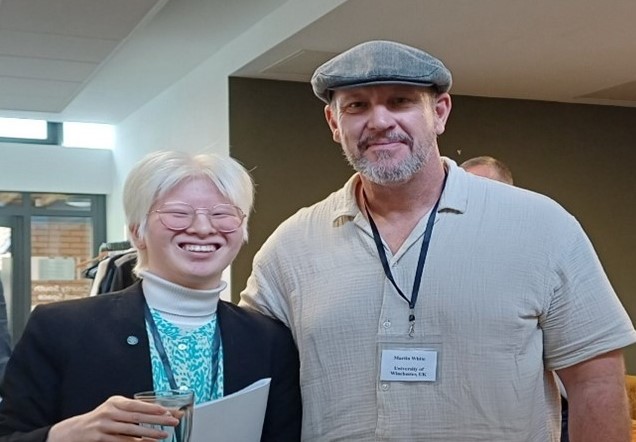
Martin White with Xueli Anne Abbing, UNESCO Goodwill Ambassador for the fight against racism and discrimination and Chairperson of the Open Eyes Foundation
Fresh from completing his Masters at the University of Winchester, author Martin White’s plans for a PhD focusing on an often-demonised section of society has been welcomed by three major charities.
His thesis, ‘The Evil Albino Trope: The Depiction of Albinism in Modern and Contemporary Fiction’ has been endorsed by the Albinism Fellowship UK & Northern Ireland, NOAH (National Organization for Albinism and Hypopigmentation) and the African-focused organisation Under the Same Sun.
Albinism is an inherited condition that affects the production of melanin, the pigment that colours the skin, hair and eyes. People with albinism can have very pale skin, almost white hair and eyelashes, and very light-coloured eyes – as a result they have been the subject of discrimination and violence down the ages.
Martin, 49, from Andover first came across the condition in his teens when he visited Kenya – albinism is more prevalent in Africa than Europe and other parts of the world.
He recalled his trip when his Masters Course in Creative Writing required him to write a story about someone from a marginalised minority.
“I realised that you almost never see a film or read a book where a person with albinism is shown in a good light,” said Martin.
Instead, the ‘evil albino’ is a stock villain in fiction epitomised by characters like Silas the psychopathic monk in The Da Vinci Code and The Twins in The Matrix Reloaded.
Such depictions can fuel fear and prejudice, argues Martin.
In Africa, where albinism affects one in a thousand (compared to one in 17,000 in Europe) superstitions about albinism abound. In Tanzania babies with albinism are often killed at birth and in Ghana it is thought that sleeping with a woman with albinism can cure AIDS and as a result many women are infected with the virus.
Martin attended the recent International Albinism Conference at Lancaster University where he met many people with the condition and was moved by their stories. He spoke to Kristina Venning-Rose, an Albinism Fellowship Trustee, who recalled that when she was seven, other children wouldn't hold her hand or play with her.
His thesis will fall into two parts – an academic study of the negative depictions of people with albinism and a novel.
Martin plans to write a Gothic Western detective story with a hero who has albinism. As many people with the condition have sight problems, he hopes to produce it in large print, Braille and audio formats.
“I hope my PhD can go some way to stopping other writers using the albinism trope,” said Martin. “At the moment young people growing up with albinism only see people like themselves as characters who are evil, deranged or weak.
“As an author I can give a marginal minority a voice. I see that as far more beneficial than anything else I can get out of writing. Helping to remove a stigma is far more rewarding than any pay cheque.”
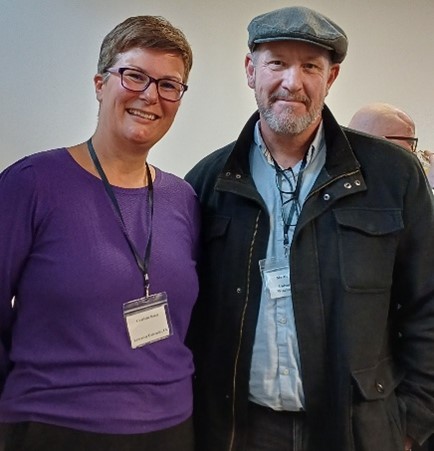
Martin with Charlotte Baker, Professor of Critical Disability Studies at Lancaster University at the recent Albinism Conference
Charlotte Baker, Professor of Critical Disability Studies at Lancaster University, who met with Martin at the Albinism Conference, said: “Beliefs and misconceptions associated with albinism that result in social stigma and exclusion are perpetuated in all forms of representation, including literature, and this needs to change. Martin’s work will contribute to challenging such misrepresentations by creating narratives in which people with albinism are more carefully represented.”
Kristina Venning, the co-chair of the Albinism Fellowship, said: “When misrepresentation is all the public sees, ignorance becomes reality. Negative portrayals of people with albinism fuel exclusion and ridicule — it’s time to end them and demand authentic representation. Growing up without positive role models and facing relentless teasing from both adults and children took a heavy toll on my mental health, leading to some very dark and difficult times.”
Glenn Fosbraey, Head of English and Creative Writing at the University of Winchester, said: “We're delighted Martin has chosen to continue his studies with us at doctoral level and his project promises to be a fascinating and important one.”
Published author Martin, who writes under the name of MJ White, began his late journey through academia at evening classes and then Andover College, where he gained a Grade A for his EPQ (Extended Project Qualification) in Creative Writing and impressed his teachers. Read his story here
Find out about the Albinism Fellowship's Albinism Mythbusters project here
Back to media centre